
Emergency Generator Options for Commercial Buildings

When the grid goes down, a business loses more than its lights. Refrigerated inventory warms while registers, servers, and security systems shut down, and customers find other places to go. The right generator keeps a building safe, operational, and open until utility service returns.
This easy-to-use guide covers emergency generators for business: the main options, how they compare, and how to choose one that fits your building.
This guide covers the following:
- Sizing starts with your critical loads, not your square footage.
- Code-required emergency power and optional business backup are two different things.
- Natural gas, diesel, and propane standby units each fit different buildings.
- Portable generators suit short-term needs, not automatic protection.
- Installation, permitting, and testing matter as much as the unit itself.
What to Consider Before Choosing a Commercial Generator
The right choice comes from a handful of decisions. Work through them before comparing models.
- Critical loads and sizing. A load calculation totals the equipment you must power, including the startup surge some motors draw. Square footage is a poor shortcut, since two buildings of the same size can need very different generators. Many owners back up only essential circuits to control cost and fuel use, while whole-building coverage is possible with proper sizing.
- Fuel type and availability. Natural gas arrives by utility line. Diesel and propane come from on-site tanks.
- Standby or portable. A standby unit is permanently installed and starts on its own. A portable unit is set up and started by hand.
- Switchover speed. An automatic transfer switch (ATS) monitors your power and moves the building to the generator within seconds.
- Code and permitting. Commercial generator installations are subject to local permitting and code requirements, which vary by jurisdiction.
- Noise and placement. Standby generator placement must account for exhaust, sound, service access, and site requirements.
- Maintenance. Regular testing keeps the unit ready when it matters.
The Difference Most Owners Miss
Backup power is not one category. For many commercial buildings, the National Electrical Code (NEC) distinguishes emergency systems under Article 700, legally required standby systems under Article 701, and optional standby systems under Article 702. Article 700 systems serve emergency loads and generally must make power available within 10 seconds. Article 701 systems serve legally required standby loads and generally require power within 60 seconds. Article 702 systems are installed by choice for business continuity rather than because a code mandates standby power.
Which category applies depends on your building, the adopted code, and the local authority having jurisdiction. Where it is adopted or referenced, NFPA 110 sets performance requirements for emergency and standby power systems, including classifications tied to restoration time and system risk.
Emergency Generator Options at a Glance
Here is how the four main options compare:
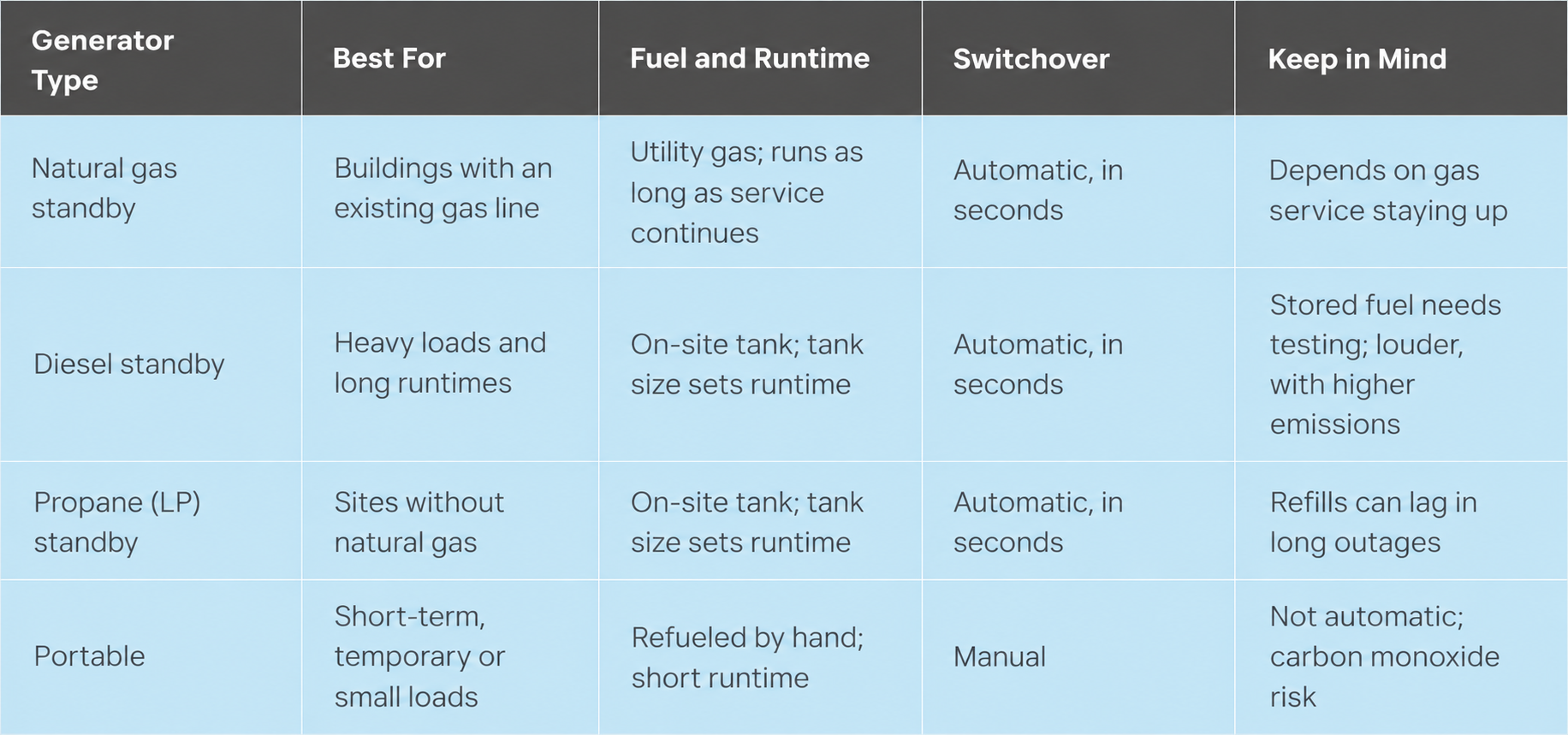
Commercial Emergency Generator Options
Natural Gas Standby Generators
Known for: A steady fuel supply from the utility line, with no tank to refill.
Best for: Offices, retail, and restaurants already connected to natural gas.
Standout: With uninterrupted utility gas service, runtime is not limited by an on-site fuel tank.
Keep in mind: If gas service is interrupted, the generator stops. Fuel-source requirements for life-safety systems can vary by code and local authority.
Diesel Standby Generators
Known for: High output from fuel stored right at the generator.
Best for: Heavy power loads and facilities that want independence from pipelines.
Standout: Runtime depends on tank size, so a larger tank means a longer run without a utility connection.
Keep in mind: Stored diesel requires fuel-quality monitoring and periodic maintenance. Noise, emissions, and storage requirements also vary by system and site.
Propane (LP) Standby Generators
Known for: Versatility where natural gas lines are not available.
Best for: Sites without natural gas service that need an on-site fuel supply.
Standout: Propane can be stored on-site for extended periods, making tank capacity easy to plan around.
Keep in mind: Runtime ends when the tank empties, so tank size and refill availability matter during extended outages.
Portable Generators
Known for: Flexibility. They move to where power is needed.
Best for: Short outages, temporary work sites, and small loads such as lights or a few registers.
Standout: A portable unit can serve more than one location, which a permanent installation cannot.
Keep in mind: Someone must place, start, and refuel it, and runtime is limited. Portable generators also produce carbon monoxide, so the CDC advises running them outdoors and more than 20 feet from windows, doors, and vents. If a portable generator connects to a building's electrical system, use a properly installed transfer switch to prevent backfeeding.
How to Choose the Right Generator for Your Building
Building type will give you a sensible starting point. Here’s what to know:
- Restaurant with refrigeration: Refrigeration, lighting, and point-of-sale may be the highest priorities. A standby unit sized for those circuits can protect inventory without powering everything.
- Office with servers: Servers, networking, and security may need uninterrupted power. A properly sized uninterruptible power supply (UPS) can bridge the brief gap before the standby generator takes over.
- Facility with elevators and fire pumps: These loads may be subject to emergency or legally required standby requirements depending on occupancy, building height, system design, and local code. That can affect transfer speed, fuel choice, and testing.
- Workshop or warehouse with large motors: Large motor starting current can be a major sizing factor, so the generator must be selected around actual load characteristics.
In every case, the real first step is a professional load calculation and code review. Brda Electric begins with an energy demand assessment that weighs your loads, power priorities, and equipment options.
Installation, Permitting, and Maintenance
A commercial standby generator is a permanent electrical system, so installation should be handled by qualified professionals. Proper installation covers:
- A load calculation to size the system
- A pad, fuel connection, and generator mounting
- Transfer switch wiring
- Permits and coordination with your utility
- Inspection and a full performance test
Each step carries code requirements, and mistakes can create safety hazards or fail an inspection. Licensed electricians handle this work as part of commercial electrical services. If your existing service is near capacity, an electrical service upgrade may be needed if the existing service lacks capacity for the generator and other equipment.
Maintenance keeps the system ready. Follow the manufacturer's recommended service schedule and the maintenance plan for your facility. Where NFPA 110 applies, generator sets in service are exercised at least monthly for a minimum of 30 minutes under specified operating or loading conditions.
Get the Right Emergency Generator for Your Business
The right generator is sized, fueled, and installed for your building's real needs and code requirements. Start with your critical loads, confirm which code category applies, and choose a fuel that fits your site.
Brda Electric is a commercial electrical contractor serving Greater St. Louis and Southern Illinois. Our licensed electricians install standby generator systems, handle permitting and performance testing, and provide preventive maintenance support.
Request a Fast Estimate or Schedule a Backup Power Consultation Today
For urgent issues, our St. Louis electricians provide 24/7 emergency response across Missouri and Southern Illinois.
Frequently Asked Questions
What size generator does a commercial building need?
It depends on your critical loads, not square footage. A load calculation adds up the equipment you need to run, plus startup surge. Some businesses back up only essential circuits, while others cover the whole building.
What is the best fuel type for a commercial standby generator?
No single fuel wins. Natural gas suits buildings with a dependable gas line. Diesel handles heavy loads with on-site fuel. Propane fills the gap where gas lines are unavailable. Local availability, target runtime, and power needs decide.
What is the difference between a standby generator and a portable generator for a business?
A standby generator is permanently installed and starts automatically through a transfer switch, usually within seconds. A portable generator is moved into place and started by hand, which suits short-term or small loads.
Does a commercial generator have to meet code requirements?
Yes. Every installation must comply with applicable local permitting and electrical code requirements. Buildings with life-safety loads such as egress lighting and fire alarms may face stricter emergency power requirements than buildings with optional backup.
How often does a commercial generator need to be serviced?
Follow the manufacturer's recommended maintenance schedule. Where NFPA 110 applies, generator sets in service are exercised at least monthly under specified operating or loading conditions.