
How to Calculate Your Household's Average Energy Consumption

The average U.S. home uses about 899 kWh per month, or roughly 30 kWh per day, according to the U.S. Energy Information Administration (EIA). That single number, your annual kilowatt-hour total, is the foundation for nearly every major energy decision a homeowner makes. Solar system sizing, battery storage capacity, generator load planning, and EV charging infrastructure all start with knowing how much electricity your home actually uses.
The national average is a useful starting point, but it may not describe your home at all. There are three reliable ways to find your own number: pulling it from your electric bill, estimating it appliance by appliance, or measuring it directly. This post walks you through each method. If you are already thinking about home electrical upgrades, knowing your baseline usage is the right place to start.
How Much Electricity Does a House Use on Average?
The National Numbers
According to the EIA, the average U.S. residential customer consumed 10,791 kWh, which works out to about 899 kWh per month and roughly 30 kWh per day. For a home close to the average size of 1,818 square feet, that translates to approximately 0.49 kWh per square foot per month. These are national averages, though, and where you live matters a great deal.
Missouri and Illinois Are Not Average
Both Missouri and Illinois experience wide seasonal swings, hot and humid summers followed by cold winters, that push home electricity use well beyond a single monthly average. Missouri residential customers averaged around 1,001 kWh per month in 2024, putting the state significantly above the national baseline. Illinois customers averaged closer to 693 kWh per month during the same period, partly reflecting different building stock, climate patterns, and fuel mix. (Source: EIA Electric Sales, Revenue, and Average Price, Table 5a.)
For Southern Illinois customers, actual monthly consumption can vary significantly from the statewide average depending on home size, heating fuel type, and whether summer cooling runs on electricity. Neither state figure tells the full story of what your home specifically uses.
Method 1: Pull It From Your Electric Bill
The fastest and most accurate way to calculate your home's energy use is already on your electric bill. Every statement from your utility shows your kWh consumed for that billing cycle. To get a meaningful annual picture:
- Add the kWh figures from your last 12 monthly statements.
- Divide by 12 to find your average monthly consumption.
- Divide any monthly figure by the number of days in that billing cycle to get your daily kWh.
A 12-month window matters because a single bill captures only one slice of your seasonal pattern. July will look nothing like January. Using a full year smooths out the peaks and gives you an annual total that's actually useful for planning purposes.
On a typical electric bill, your kWh usage appears prominently on the front summary section, often alongside a usage history chart comparing this month to the prior year. Your online account usually shows a downloadable history going back multiple years, which makes the 12-month calculation easy to run without digging through paper.
Method 2: Estimating Power Consumption Appliance by Appliance
Watts, Kilowatts, and Kilowatt-Hours, Explained Simply
Watts (W) measure the rate at which an appliance draws power at any given moment. A lightbulb and a clothes dryer both use watts; the dryer just uses a lot more of them.
Kilowatts (kW) are simply watts divided by 1,000. A 3,000-watt dryer is a 3 kW dryer. Most appliance specs and utility bills use kilowatts or kilowatt-hours because watt-scale numbers get unwieldy.
Kilowatt-hours (kWh) measure energy consumed over time, specifically one kilowatt running for one hour. This is what your utility bills you for. Running a 3 kW dryer for one hour uses 3 kWh. Running a 150-watt refrigerator for 24 hours uses 3.6 kWh.
The Formula
To compute power consumption for any appliance, use this formula:
Watts x hours used per day / 1,000 = daily kWh
Daily kWh x 365 = annual kWh
Here is a worked example using an electric kettle rated at 1,500 watts, used for 15 minutes (0.25 hours) each morning:
1,500 W x 0.25 hours / 1,000 = 0.375 kWh per day
0.375 kWh x 365 = 136.9 kWh per year
That method comes from the Department of Energy's appliance energy estimator. Apply the same formula to every appliance in your home and sum the results to estimate your total annual consumption.
Where to Find an Appliance's Wattage
Three reliable sources:
- The nameplate or label on the appliance itself (usually on the back or bottom).
- The owner's manual or manufacturer's product page.
- If only amps are listed, multiply amps x volts (120 or 240 for most home appliances) to get watts.
The table below shows typical wattages for common household loads. Treat these as illustrative samples; actual consumption varies by model, age, and usage pattern.
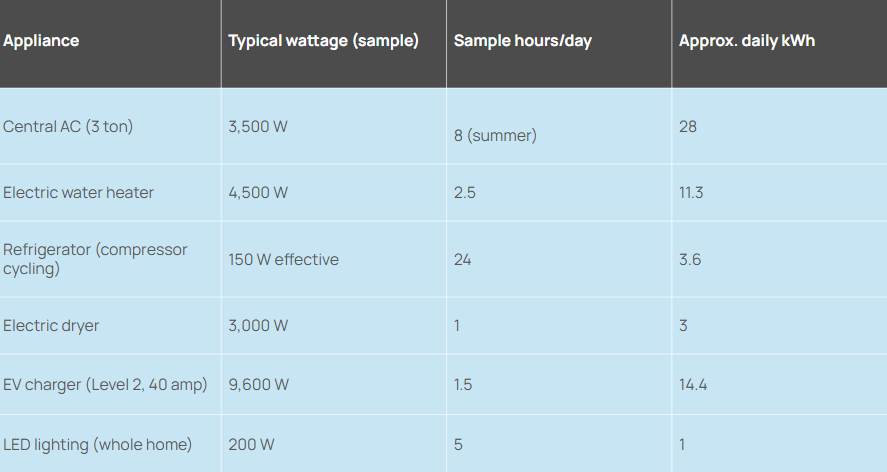
A single Level 2 charging session can be one of the largest electrical loads in a home, comparable to several hours of operation from other major appliances such as central air conditioning, depending on equipment size and usage patterns. If you add an EV to your household, your annual kWh total can increase substantially. The Brda Electric EV charging buyer's guide covers the full load picture for homeowners evaluating an EV charger installation.
Method 3: Measure It Instead of Estimating
Plug-In Usage Monitors
For 120-volt devices, inexpensive plug-in energy monitors are a practical measurement tool. You plug the monitor into the wall, plug your appliance into the monitor, and let it run for a day or a week. The device reports actual kWh consumed, no estimation required. The Department of Energy recommends these monitors specifically for tracking phantom loads, the electricity appliances draw even when switched off or in standby mode. Phantom loads can add up to a meaningful share of a home's total usage.
Whole-Home and Circuit-Level Monitoring
Plug-in monitors have one significant limitation: they only work for 120-volt appliances. Your biggest loads: central air conditioning, an electric dryer, an EV charger, and an electric water heater, all run on 240 volts and cannot be monitored with a plug-in device.
The modern answer is a smart electrical panel. A smart panel monitors every circuit in your home, including 240-volt loads, in real time and reports usage by circuit through an app. Instead of estimating that your AC ran for eight hours, you can see exactly how many kWh it consumed yesterday, last week, or last summer. That level of visibility turns energy management from guesswork into an informed decision.
What Uses the Most Electricity in a Home?
According to the EIA, space cooling and heating account for the largest share of residential electricity use nationally, with air conditioning alone representing nearly a fifth of total home electricity consumption. After HVAC, the next biggest categories are:
- Water heating
- Refrigeration
- Laundry appliances (washer and dryer)
- Lighting and electronics
If you are working through the appliance-by-appliance method in Method 2, this ranking is a useful sanity check. Your AC, water heater, and refrigerator should account for the majority of your total. If your estimate puts lighting at the top, something is off in the math.
A Realistic St. Louis Example
Consider an illustrative 1,800 square foot home in the St. Louis metro area. In a typical year, monthly consumption might look something like this:
- June through August: 1,200 to 1,500 kWh per month as central AC carries the load through humid, 90-plus-degree stretches.
- December through February: 900 to 1,100 kWh per month as the furnace blower, electric resistance heating elements, and lighting offset shorter days.
- Spring and fall: 500 to 700 kWh per month during shoulder months when neither cooling nor heating dominates.
Annualized, those swings average out to somewhere around 11,000 to 12,000 kWh per year, close to but above the national figure, reflecting Missouri's more demanding climate. The point is that a single month's bill, pulled in May or October, tells a misleading story. Only a full year of data reveals what your home actually costs to run.
All figures above are illustrative. Your home's actual usage depends on square footage, insulation, appliance age, occupancy, and thermostat settings.
What to Do With Your Number
If Your Usage Looks High
Start with the basics before assuming something is wrong. Check thermostat settings, look for phantom loads on plug-in monitors, and review whether your lighting has been fully converted to LED. These steps address the most common sources of unnecessary consumption.
If your usage is unexpectedly high and efficiency steps do not move the number, it may be worth having a licensed electrician take a look. Failing appliances, aging wiring, and electrical faults can all create abnormal draws that show up on your bill before they become safety issues. A home electrical safety inspection is a practical first step when usage spikes cannot be explained by behavior or seasonal patterns.
If You Are Planning Solar, Battery Storage, or an EV
Your annual kWh total is the primary sizing input for all three technologies. Solar system design starts with your household's annual consumption to determine how many panels, and how much production, your home needs. Battery storage sizing depends on how much daily kWh you want to cover. EV charger planning requires an accurate picture of your home's existing electrical load so the new circuit can be sized appropriately. In some homes, a load calculation may also determine whether load management or panel upgrades are needed before installation.
Brda Electric handles all three. Residential solar installation starts with a usage review so the system is designed around your actual home, not a national average.
Take Control of Your Home's Energy Use with Brda Electric
Brda Electric is a family-owned electrical contractor with 37 years serving the St. Louis metro area and Southern Illinois. If you are planning a full solar and battery storage installation, understanding your energy use is the right starting point.
For homeowners who want circuit-level detail without the manual work, smart panel installation gives you a live view of every load in your home from an app. Brda electricians handle the installation, permitting, and setup from end to end.
Household Energy Use FAQs
How many kWh per day is normal for a house?
The national average is about 30 kWh per day, based on EIA data showing average annual residential consumption of 10,791 kWh. In practice, daily usage varies widely depending on home size, climate, heating and cooling type, and occupancy. A smaller home in a mild climate might average 15 to 20 kWh per day, while a larger home in Missouri running central AC through a hot summer can easily reach 50 kWh or more on peak days. The most accurate way to know your daily average is to pull 12 months of kWh from your utility account and divide the annual total by 365.
What is the difference between power and energy?
Power is the rate of electricity use at a given moment, measured in watts or kilowatts. Energy is the total amount of electricity consumed over a period of time, measured in kilowatt-hours. Your utility bills you for energy (kWh), not power (kW), because the bill reflects how long each appliance ran, not just how many watts it drew. A 100-watt lightbulb left on for 10 hours consumes 1 kWh. A 3,000-watt dryer run for 20 minutes consumes 1 kWh. Same energy, but very different power.
Why is my electric bill high when my usage seems normal?
A few common explanations: seasonal shifts (summer AC and winter heating are the biggest movers and can double or triple a shoulder-month bill), phantom loads from devices on standby, aging appliances that draw more power than their rated wattage as components wear, and occasionally an electrical fault that creates an unexpected draw. If your kWh usage looks normal on the bill but the dollar amount jumped, that is a pricing issue rather than a consumption issue. If the kWh total itself is higher than expected, start with a plug-in monitor on high-draw devices and consider a professional inspection if the source remains unclear.