
A Business Owner's Guide to Power Outages and Electrical Emergencies

When the power fails, the clock starts on lost sales, spoiled inventory, and idle employees. An electrical emergency is a safety issue first, but for a business, it is also a revenue issue.
This guide is a practical survival plan for emergency electrical repairs for businesses. It covers what to do in the moment, who to call, and how to prevent the next outage from becoming a crisis.
Main points:
- Some electrical problems need an immediate call, while others can wait for scheduled service.
- If nearby businesses still have power, the problem is likely inside your building.
- The utility handles downed lines and area outages, and an electrician handles faults on your side.
- A standby generator, surge protection, and a written plan reduce downtime.
- Never re-energize equipment after a fault or water exposure until a professional inspects it.
What Counts as an Electrical Emergency for a Business?
Not every electrical issue requires a call at midnight. The table below shows what needs immediate help and what can wait for scheduled service.
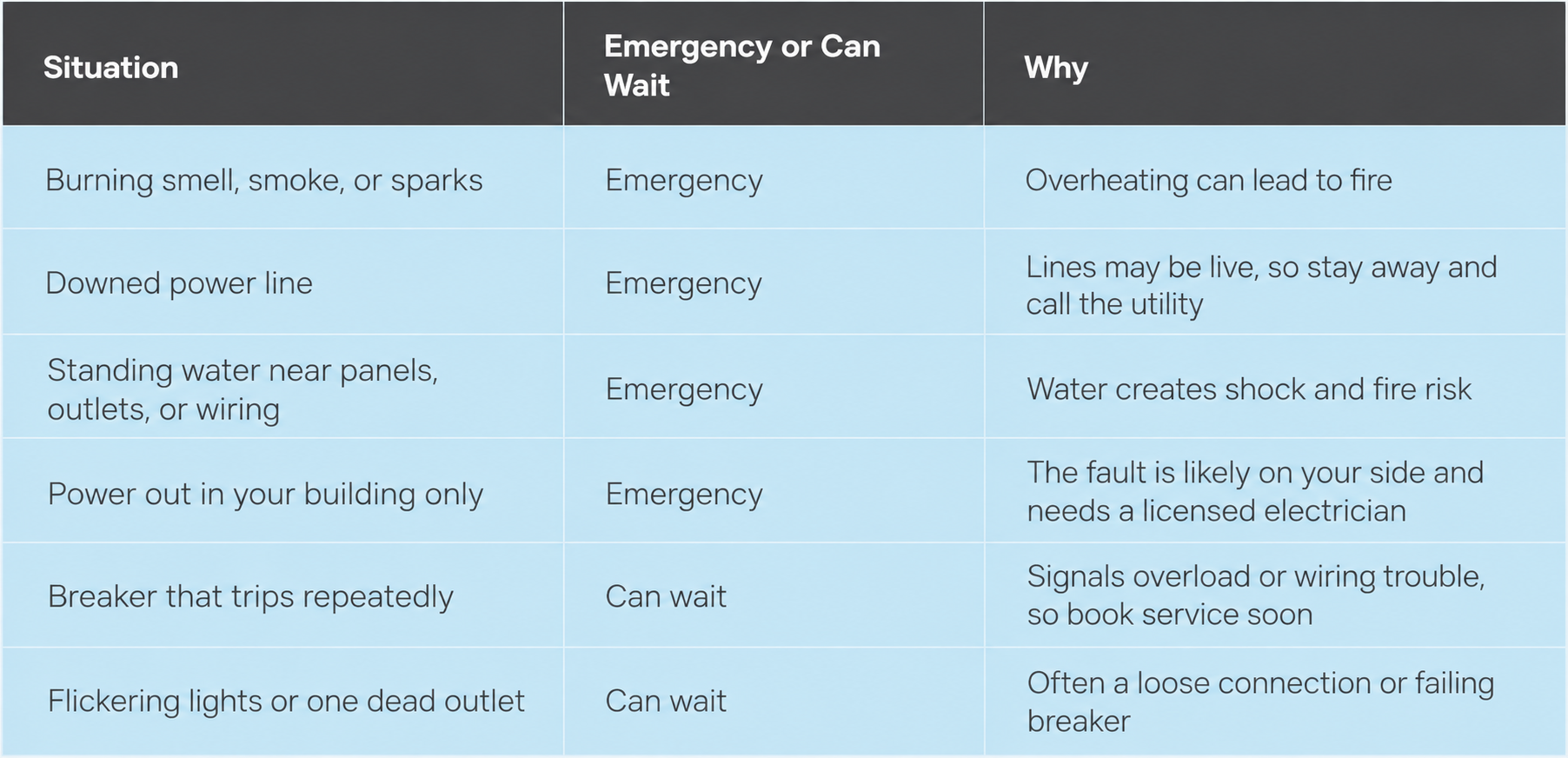
Common Causes of Commercial Power Outages and Electrical Failures
Most commercial power outages trace back to one of these causes:
- External utility issues: Equipment failures, traffic accidents, and construction work can interrupt service.
- Storm damage: Wind, lightning, and ice damage lines, poles, and transformers.
- Tripped breakers: An overloaded circuit shuts itself off.
- Overloaded or aging panels: Older panels struggle with high-power equipment, and tripping breakers and dimming lights are common warning signs that one needs attention.
- Faulty wiring: Worn or damaged wiring creates failures and safety hazards.
- Equipment faults: A failing piece of equipment can trip a breaker and take a circuit down.
Start with a quick self-check by looking outside. If nearby businesses still have power, the problem is likely internal, so check your breakers and fuses first. After a storm, report it to your utility anyway.
What to Do When the Power Goes Out
Keep it simple and put safety first:
- Keep people clear of hazards. Move staff and customers away from sparks, smoke, standing water, and downed lines. Call 911 for fire or injury.
- Shut down sensitive equipment in a controlled way. Save work, shut down computers and servers, then unplug or switch off equipment. Power can return with momentary surges or spikes that damage electronics.
- Run generators outdoors only. Keep portable generators at least 20 feet from windows, doors, and other openings. Connect one to building wiring only through a transfer switch installed by a licensed electrician.
- Do not re-energize a system you do not understand. Do not repeatedly reset a tripping breaker or open a panel. Call a licensed electrician instead.
Who to Call: Your Utility or an Electrician?
Many business owners get this split wrong. The utility typically owns the lines that bring power to your property and the meter. You own the service equipment on your side, including the service bracket, weatherhead, pipe riser, and meter box, and a licensed electrician must repair any damage to it.
Downed Lines and Area Outages: Call Your Utility
Your utility is the company on your electric bill, and in much of the St. Louis area that is Ameren. Some Southern Illinois businesses are served by electric cooperatives instead, so check your bill before you call.
Stay far away from downed lines, assume they are live, and report them immediately. Ameren's numbers are 800-552-7583 in Missouri and 800-755-5000 in Illinois, and you can also report an outage online. Call 911 if anyone is in danger.
Internal Faults: Call an Electrician
Tripped breakers, failed panels, faulty wiring, and equipment faults are electrician jobs. Brda Electric's licensed commercial electricians diagnose and repair these problems so you can reopen safely.
How to Prepare Your Business for the Next Outage
These safeguards reduce downtime:
- Standby generator with an automatic transfer switch: The switch detects an outage, starts the generator, and moves your load to backup power within seconds. A standby generator can power dedicated circuits or an entire facility.
- Uninterruptible power supplies (UPS): Operations that cannot tolerate any interruption add a UPS to keep service steady for critical electronics.
- Whole-building surge protection: It guards equipment against voltage spikes from lightning, utility switching, and nearby outages.
- Code-compliant emergency and exit lighting: It keeps exit routes visible when the lights go out.
- Preventive maintenance: Routine inspections catch worn connections before they fail, and generators need service on the manufacturer's schedule, commonly every six to 12 months.
Then put your plan in writing. A continuity plan identifies your critical circuits and systems, such as refrigeration, security, and data, and names who makes decisions and how you will reach staff and customers. The same list guides generator sizing, since many businesses back up only essential circuits.
After the Emergency: Getting Back to Business Safely
Recovery is a safety window, not just a return to normal.
- Get a professional inspection before you re-energize. After a fault or water exposure, have a licensed electrician inspect affected equipment before you restore power. The Electrical Safety Foundation International recommends this step for any submerged or water-damaged electrical equipment.
- Document the damage. Photograph or video damaged equipment, list what was affected, keep repair receipts, and notify your insurer promptly.
- Food-service and grocery operators: A closed refrigerator stays cold for about four hours and a full freezer for about 48 hours. USDA guidance says to throw out perishables that have been above 40 degrees Fahrenheit for two hours or more.
When to Call a Licensed Electrician
Build a relationship with a commercial emergency electrician before you need one. An electrician who already knows your building can diagnose problems faster when it matters most. Look for:
- Licensing and insurance
- Commercial experience
- Fast response times
- 24/7 availability
Brda's electricians are licensed, insured, and safety trained, and 24/7 emergency electrical services are available across the St. Louis and Southern Illinois service areas.
The best emergency is the one that never happens. Preventive maintenance and panel or service upgrades address causes behind many outages, from overloaded panels to aging breakers.
Plan Ahead So the Next Outage Does Not Stop Your Business
The businesses that weather an outage best are the ones that planned for it. Know what counts as an emergency, keep the right numbers handy, and put backup power and maintenance in place before the next storm.
Brda Electric is a family-owned electrical contractor with deep experience keeping St. Louis and Southern Illinois businesses powered, safe, and code-compliant. Brda's licensed electricians handle everything from emergency repairs to standby generators and panel upgrades.
Call Brda Electric's 24/7 Emergency Line for Urgent Commercial Issues at (636) 343-0504.
Frequently Asked Questions
What should I do if my business loses power but nearby buildings still have electricity?
Check your breakers and fuses first. If that does not restore power, call a licensed electrician, because the fault is likely on your side of the meter. After a storm, also report it to your utility company.
Who do I call when my commercial building has an electrical emergency?
Call 911 for fire, injury, or immediate danger. Call your utility, usually Ameren, for downed lines and area outages. Call a licensed emergency electrician for faults inside your building.
How can a backup generator keep my business running during an outage?
A standby generator's automatic transfer switch detects the outage, starts the generator, and switches your power supply within seconds. It can power dedicated circuits or the whole facility.
What are the signs my business needs an emergency electrical repair?
Burning smells, sparks, smoke, hot or buzzing breakers, standing water near wiring, and a building-wide power loss all call for immediate help.
How often should a commercial building have its electrical system inspected?
NFPA 70B, the national standard for electrical equipment maintenance, bases inspection frequency on the condition of your equipment rather than a fixed calendar. For panelboards, circuit breakers, and switches, that means maintenance every five years for equipment in good condition, every three years in fair condition, and every year in poor condition. The standard also calls for infrared scans of electrical equipment at least once a year to spot hot connections before they fail. A licensed electrician can assess your equipment and build a schedule for your building.