
Electrical Panel Considerations for Adding an EV Charger

Most home EV chargers run at 40 or 48 amps on a 50 or 60 amp circuit, and whether your panel can take one depends on your service size and what else is already pulling power from it. Before you pick a charger, it helps to know how amperage, breaker size, and your home's existing electrical load fit together.
Brda Electric's home EV charger installation service covers the panel check, circuit installation, and permitting in one project, which makes it easier to handle amperage questions and panel readiness together rather than as separate steps. Charger types and charging speeds covered in the EV charging buyer's guide are worth understanding before you get into amperage specifics.
This guide walks through the numbers, what an electrician checks on your panel, and what your options are if the panel needs help keeping up.
What Amperage Do You Need for a Car Charger?
Common Level 2 Charger Sizes
Level 2 chargers come in a handful of standard sizes, and each one calls for a specific breaker. The table below lays out the most common options.
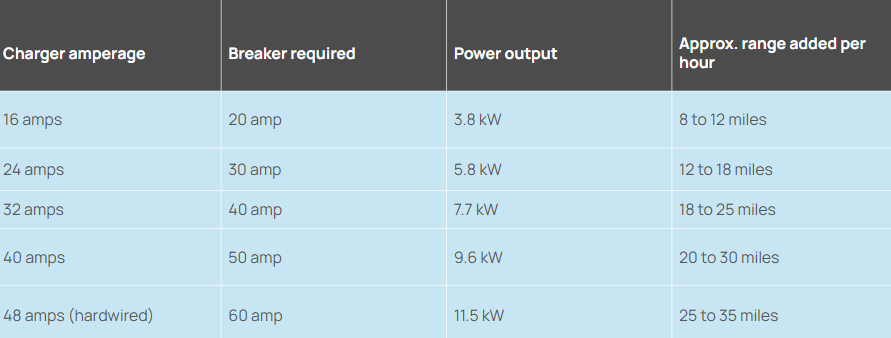
Reference figures compiled from NEC-based guidance. Range added per hour varies by vehicle efficiency and is approximate.
The 80 Percent Rule in Plain English
EV charging counts as a continuous load, which means code requires the charger to run at no more than 80 percent of its breaker's rating. That's why a 50 amp breaker pairs with a 40 amp charger, and a 60 amp breaker pairs with a 48 amp charger. The breaker isn't undersized. It's built in headroom so the circuit can run for hours at a stretch without overheating.
Your Car Sets the Ceiling
A Level 2 charger can typically add approximately 10–75 miles of range per hour, depending on the charger and vehicle. Even when a 48 amp charger is installed, the vehicle's onboard charger determines how much power the vehicle can actually accept.
Can Your Electrical Panel Handle an EV Charger?
Find Your Service Size
Your main breaker, usually at the top of the panel, lists your home's total service size: typically 100, 150, or 200 amps. A 200 amp panel usually has room to spare for a 40 to 60 amp EV circuit. A 100 amp panel is a tighter fit and often needs a closer look at what else is running before a charger circuit gets added.
Signs Your Panel Is Near Capacity
A few signs point to a panel that's already working hard: breaker slots that are completely full, breakers that trip more than occasionally, a panel that predates most of the appliances now plugged into it, or a past addition like a hot tub or an electric range conversion that already claimed a chunk of capacity.
Plenty of homes across the St. Louis area were built decades before EVs were part of the picture and still run on 100 amp service today, which is exactly the kind of home where this check matters most.
The Load Calculation: What an Electrician Actually Checks
Before installing an EV charger circuit, an electrician runs a load calculation: essentially, adding up everything in the home that could draw power at the same time and comparing that total against the panel's capacity. In a St. Louis summer, that means accounting for the air conditioning load alongside the electric range, dryer, and water heater. The goal is to see how much headroom is actually left, not just how much the panel is rated for on paper.
To make that concrete, picture a fairly typical St. Louis-area home on 100 amp service during a July afternoon. A central air conditioner pulling around 20 to 30 amps is already running. The electric range, when in use, can draw another 30 to 40 amps. Add a 20 to 30 amp electric dryer and a 20 to 25 amp electric water heater, and a home can be leaning on a meaningful share of its 100 amp service before an EV charger ever enters the picture.
That doesn't necessarily rule out a charger circuit. Not everything runs at once, and an electrician's load calculation accounts for that using NEC-based demand factors rather than simply adding up every appliance's worst-case draw. But it does explain why a homeowner with a full panel and an aging 100 amp service can't safely guess their way into a 40 or 50 amp charger circuit. The calculation is what turns "probably fine" into a number you can actually build a permit application around.
Skipping this step and guessing at capacity is risky. It can lead to nuisance tripping or an overloaded panel. On the other hand, paying for a bigger upgrade than the home actually needs wastes money. A proper load calculation is what tells you which side of that line your home falls on.
Panel capacity rarely gets upgraded in isolation. Homeowners often pair it with other projects covered in Brda's guide to home electrical upgrades, from surge protection to smart panel features.
Plug-In vs. Hardwired Chargers
Plug-in Level 2 chargers connect through a NEMA 14-50 outlet and are capped at 40 amps under code. Hardwired units skip the outlet, wiring directly into the circuit, and can run up to 48 amps with fewer connection points to maintain over time.
One outlet that won't work for this, despite looking similar: an existing dryer outlet. It's tempting to reuse it, but the wiring behind a dryer outlet was sized for a dryer's load profile, not for a continuous, hours-long EV charging session, so it usually can't safely feed a fast charger.
What If Your Panel Cannot Handle It?
Panel or Service Upgrade
When the load calculation shows there's not enough room, a panel or service upgrade adds the capacity needed for the new circuit, along with room for whatever comes next. That's the kind of project Brda's panel and service upgrade service handles from the initial assessment through the final inspection.
Load Management and Smart Panels
A panel upgrade isn't always the only path forward. A smart panel can balance loads across the home so the EV charger only draws power when capacity allows, which sometimes avoids a full service upgrade altogether. For homes where a straightforward upgrade isn't the most cost-effective fit, Brda's smart panel and load balancing service handles the assessment and installation of that kind of system.
Permits, Inspections, and Code in the St. Louis Area
A dedicated circuit, a permit, and an inspection are standard parts of adding an EV charger, and the exact requirements vary by municipality across the St. Louis metro and Southern Illinois. St. Louis County Public Works and the City of St. Louis Building Division both require an electrical permit and inspection for a new EV charger circuit, and homeowners in St. Charles County, Jefferson County, and other surrounding counties typically go through a similar process with their own local building department.
Southern Illinois municipalities handle permitting independently as well, so a homeowner in Troy or Edwardsville may encounter a different application process than one in Fenton or Chesterfield, even though the underlying NEC requirements are the same. The permit itself generally calls for a load calculation, an equipment list, and a site diagram showing where the new circuit runs, and the project isn't considered complete until a local inspector has signed off.
Brda handles the permitting process from application through final inspection, so homeowners don't have to track down the right office for their city or county.
Get Your Panel EV-Ready with Brda Electric
Brda Electric is a family-owned electrical contractor that has served the St. Louis area for 37 years. Licensed Brda electricians start every EV charger project the same way: assess the panel, right-size the circuit for the charger you've chosen, pull the permit, install the circuit, and test the finished system before calling the job done.
Ready to find out what your panel can handle? Schedule a Service and a Brda electrician will walk you through it.
EV Charger Amperage FAQs
Can I just plug my EV charger into a dryer outlet?
Usually not safely. A dryer outlet's wiring is sized for a dryer's specific load, not for the continuous, multi-hour draw of EV charging. A dryer cycles on and off as it heats, while a charger pulls a steady load for hours at a stretch, and the wire gauge behind a dryer outlet usually isn't rated for that kind of sustained draw. A dedicated circuit sized for the charger is the safer route.
Do I need 200 amp service for an EV charger?
Not always. Whether you need a bigger service comes down to what the load calculation shows for your specific home. Some homes with 100 or 150 amp service have enough spare capacity already, and load management can sometimes bridge the gap for homes that don't. A 150 amp service with open breaker slots can sometimes handle an EV circuit more easily than a 200 amp service that's already near capacity, which is why the load calculation matters more than the number on the main breaker.
Is a 40 amp or 48 amp charger better?
It depends on the install and the driver. A 48 amp charger needs hardwiring and a 60 amp breaker, while a 40 amp charger works with either a plug-in or hardwired setup on a 50 amp breaker. For most daily driving, 40 amps is plenty. Drivers with longer commutes or more than one EV at home are the ones most likely to notice the difference overnight.
How long does EV charger installation take?
The process generally moves through a panel assessment, permit filing, the installation itself, and final testing. Permit timelines vary the most since they depend on the municipality rather than the electrical work itself. Your Brda electrician can walk you through what each step looks like for your specific home once the panel check is complete.