
LED vs. CFL vs. Smart Lighting: What’s Best for Your Home?

Choosing the right lighting can have a big impact on your home’s comfort, energy use and monthly utility bills. Some of the most popular options on the market today are light-emitting diodes (LEDs), compact fluorescent lamps (CFLs) and smart lighting.
While all of them are marketed as efficient, they’re not created equal. In fact, there’s a clear winner for residential lighting.
With 37 years’ experience helping homeowners upgrade their lighting, Brda Electric knows the ins and outs of the compact fluorescent vs LED vs smart lighting debate. Below, we’ll break down each option’s performance to help you decide which is best for you.
LED vs. CFL vs. Smart Lighting at a Glance
In contrast with incandescent bulbs, which heat a filament until it’s white hot, LEDs create light as a byproduct of electron movement within a semiconductor. CFLs work by exciting gases in a bulb (argon and mercury). Smart bulbs use many different underlying technologies to produce light, but the determining factor is integrated remote and/or automatic on/off functionality.
In a nutshell, LEDs are the most efficient of the three because they produce the least amount of heat. They also last longer while emitting the same light quality, with fewer concerns aside from being slightly more expensive. What’s more, they’re best suited for all use cases except for temporary or low-traffic areas.
Here’s an overview of how each option stacks up across most people’s high-priority features:
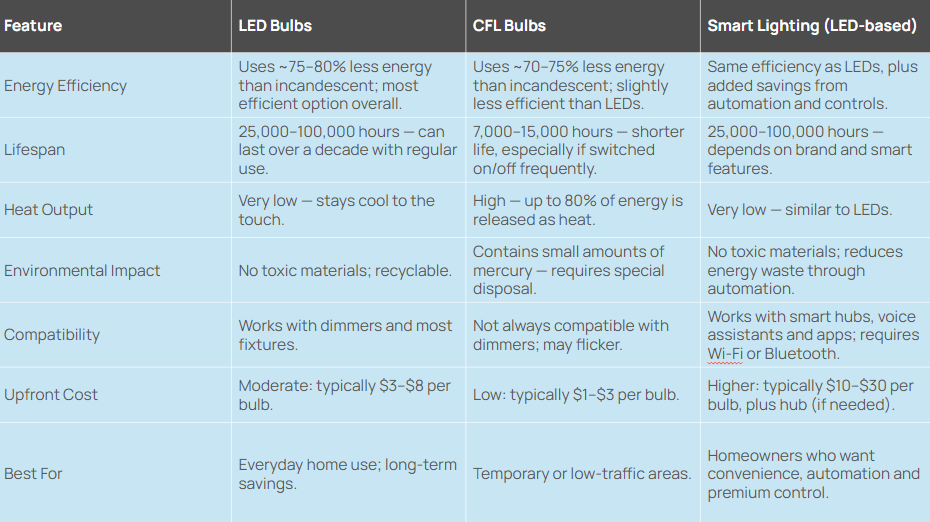
Energy Efficiency: LEDs Lead the Way
Both LEDs and CFLs offer great energy efficiency. CFLs and LEDs are at least 75% more efficient than incandescent bulbs, on average, with LEDs having a greater potential because of how they work. Notably, CFLs release about 80% of their energy as heat, while LEDs release little to no heat.
In practice, CFL replaces a 100-watt incandescent with 60 watts, while LED does it with 14.
That energy saving translates to lower energy costs. In fact, the Department of Energy (DOE) estimates that the average household saves about $225 per year with LED lights instead of incandescent.
For these reasons, LEDs are an essential electrical upgrade that will help you save long-term.
Lifespan and Long-Term Value
Another factor to consider is how long LEDs last: typically 25,000–100,000 hours, or up to 25 times as long as incandescent bulbs. They also last about three or four times as long as most CFLs (~7,000–15,000 hours). Smart bulbs are harder to pin down, as the specifics of their smart technology can vary widely and determine longevity.
A longer lifespan means fewer replacements, lower waste and better long-term savings. Even though LEDs often cost a bit more upfront, the investment pays for itself over time as you spend less on energy bills year in and year out. And when you do need to replace LED bulbs, it’s easier to do so, as CFLs require specialized disposal because of the argon and mercury within them.
Drawbacks of CFL Bulbs
Aside from the inherent positives of LEDs, there are also some potential drawbacks of CFLs that make them less appealing to homeowners.
- CFL bulbs sometimes have a delay, needing to warm up before emitting their full brightness. This has changed somewhat in recent years with newer bulbs, but it’s an underlying issue with the technology. Similarly, many homeowners find that CFL bulbs flicker, and both problems are exacerbated when bulbs are turned on/off frequently.
- There are also inherent safety and environmental concerns with CFLs. The small amount of mercury in them needs to be disposed of properly, which can be an unnecessary hassle.
- Finally, there’s a question of long-term support, as a piece of 2024 legislation from the DOE seeks to phase out CFL bulbs by as early as 2028. Lawmakers, environmental activists and others are pushing for an LED-focused future of lighting in the US, in part because of these inherent issues.
LED Advantages and Smart Lighting Innovation
LEDs are the way forward, with or without smart technology. And because CFLs are being phased out, many smart bulb manufacturers are already using LED as the default for their enhanced bulbs.
Ultimately, LEDs and smart lights are winning out thanks to their performance and convenience.
Why LEDs Win on Performance
There are several reasons why LEDs perform better than CFLs:
- While CFLs can take a second to reach full brightness, no such limitation exists for LEDs. They offer instantaneous light at 100% brightness the moment the switch is flipped. They also tend to come in more color options, both in terms of lumens and actual tinted light.
- Another major aesthetic factor is dimmer compatibility. While some CFL bulbs are dimmable, many are not. And, even with dimmer-compatible CFLs, a common complaint is that their dimming quality is subpar compared to incandescents. In contrast, dimmable LEDs function much more similarly to incandescents, with great control.
- LEDs and smart bulbs using LED technology also provide light without relying on toxic materials, so the efficiency and aesthetic benefits don’t come with convenience, safety or ecological costs.
Smart Lighting: A Step Forward in Convenience
Smart bulbs build on the efficiency of LEDs with added convenience and functionality. They allow homeowners to control exactly how their spaces are lit, improving both efficiency and comfort.
The core benefits of smart bulbs that use LED technology are:
- Convenience – Smart LEDs are controlled via voice control or through an app
- Automation – Lighting can be synced to a schedule and/or with other devices
- Customization – Most smart bulbs have color, brightness and tone options
- Enhanced Efficiency – Motion sensors and remote access reduce waste
These are ideal for any homeowner looking for the highest-end, luxury lighting option.
Choosing the Right Lighting for Your Home
Ultimately, the best lighting for any home depends on its owners’ goals. A basic LED bulb without built-in smart features is the best choice for the budget-conscious. If you’re lighting a temporary or low-use space, CFLs might suffice, but a basic LED will perform better for longer and cost less over time. Tech-forward homeowners and those who want the most luxurious option should seek out smart lighting systems that utilize LED technology.
It’s also worth noting that you don’t have to go all-in on one lighting source. Mixing up your bulbs across different rooms can help meet different needs.
Once you’ve decided on bulbs, Brda’s residential lighting experts will help you install or upgrade your home’s lighting, ensuring it’s exactly what you want.
Optimize Your Lighting Today
The difference between compact fluorescent vs LED vs smart lighting options is relatively straightforward. While CFLs are an upgrade over incandescent bulbs, there’s a reason they’re being phased out: LEDs deliver the best mix of efficiency, longevity and performance. And LEDs with smart lighting offer added convenience, maximizing your efficiency while giving you aesthetic options.
At Brda Electric, we believe every homeowner should have lighting that fits their needs. Contact us today for a fast estimate and find the right lighting upgrade for your home.
Sources:
GE Lighting. CFL vs LED Light Bulbs – Frequently Asked Questions. https://www.gelighting.com/inform/cfl-led-debunking-myths
How stuff works. How CFL Bulbs Work. https://science.howstuffworks.com/environmental/green-tech/sustainable/cfl-bulb.htm
How stuff works. How Light Emitting Diodes (LEDs) Work. https://electronics.howstuffworks.com/led.htm
The National Law Review. Biden Administration Sets 2028 as the Date to Unplug Sale of Most CFLs Under Energy Efficiency Standards. https://natlawreview.com/article/biden-administration-sets-2028-date-unplug-sale-most-cfls-under-energy-efficiency
U.S. Department of Energy. Lighting Choices to Save You Money. https://www.energy.gov/energysaver/lighting-choices-save-you-money